
How Communities Reacted During Major Civil Emergencies
School emergency planning feels modern, but history keeps showing the same family problem: children, uncertainty, communication, and decisions made before parents have perfect information.
The short version
When a civil emergency touches children, the hard part is rarely just the hazard. The hard part is separation: parents trying to reach children, schools trying to account for students, officials trying to move people safely, and families making decisions before the picture is clear.
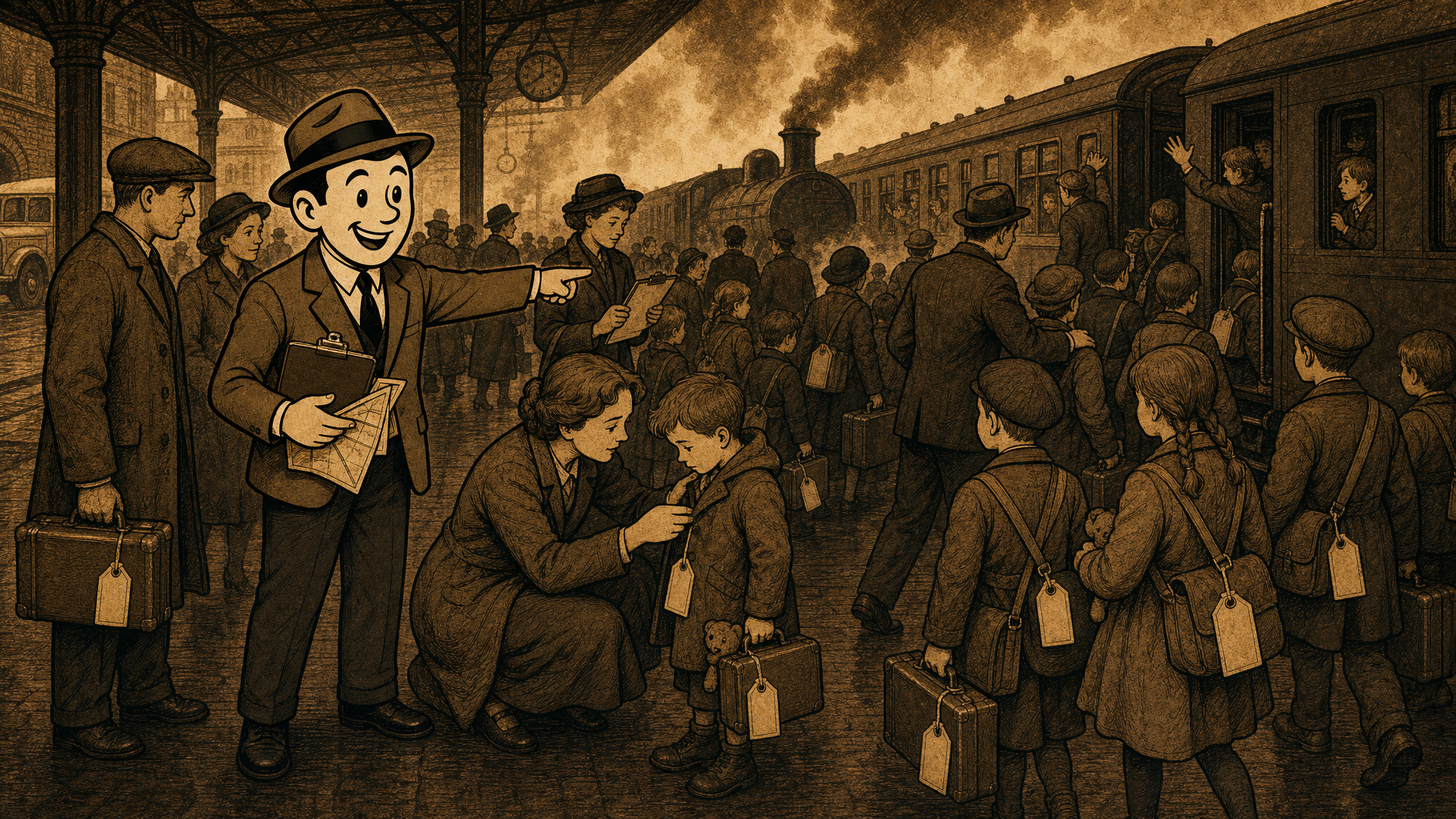
One of the clearest historical examples is Britain’s wartime child evacuation in 1939. Imperial War Museums describes how fear of German bombing led the government to evacuate children, mothers with infants, and vulnerable people from towns and cities. The first wave began on 1 September 1939. Over three days, about 1.5 million evacuees were sent to safer rural locations.
That pattern is older than smartphones and newer than any single school policy. History has receipts, and most of them are written in worried parent handwriting.
What ordinary families were deciding
It is easy, from a safe distance, to treat mass evacuation as a clean government operation. For families inside it, the choice was more human.
Evacuation was voluntary, but IWM notes that fear of bombing, closed urban schools, and organized transport of school groups helped persuade families. Parents were not choosing between “danger” and “safety” on a neat menu. They were choosing between keeping children close in cities expected to be bombed or sending them away with teachers, labels, luggage, and incomplete certainty about where life would land next.
Reasonable people made different calls. Some sent children away. Some kept them home. Some brought children back when the expected bombing did not immediately arrive. That is not foolishness. That is a normal family trying to protect children while the facts keep moving.
The community machinery mattered
The history is not just parents and trains. It is teachers, reception areas, billets, local officials, forms, lists, transportation, rumor control, and thousands of small handoffs. The National Archives notes that most records connected to evacuation are central government policy files, which tells us something important: child safety during a civil emergency becomes an administrative problem as much as an emotional one.
The modern lesson hiding in the old scene
Modern school emergencies look different. The hazard may be weather, wildfire smoke, a nearby police situation, a transportation shutdown, flooding, power failure, a chemical spill, or another threat that makes normal dismissal unsafe. But the family pressure has not changed much.
Parents still want to go straight to the school. Schools still need to account for every child. Roads can clog. Phones can fail. Rumors can outrun confirmed facts. A child may be physically safe but emotionally shaken. A parent may be calm in theory and absolutely not calm when the pickup plan changes.
Read the rest of this cluster
This historical pattern leads directly into a modern parent question: what if the school has to keep kids longer than expected, possibly overnight? Then it becomes a household action plan.
Sources used for this field guide
- Imperial War Museums: The Evacuated Children Of The Second World War, source.
- UK Government History Blog: Child Evacuees in the Second World War: Operation Pied Piper at 80, source.
- The National Archives: Government evacuation scheme, source.
- The National Archives: Evacuees research guide, source.
- FEMA: Guide for Developing High-Quality School Emergency Operations Plans, source.
- DOJ COPS Office: Student-Parent Reunification after a School Crisis, source.
- Ready.gov Kids: Make a Plan, source.
- Ready.gov: Make A Plan, source.
Defeat the pattern before it reaches your house
History does not hand families certainty. It hands them patterns. Choose one contact, one backup adult, and one calm sentence your child can remember before the weird day arrives.
Browse the Field Library or see Defeat History tools and guides.
