
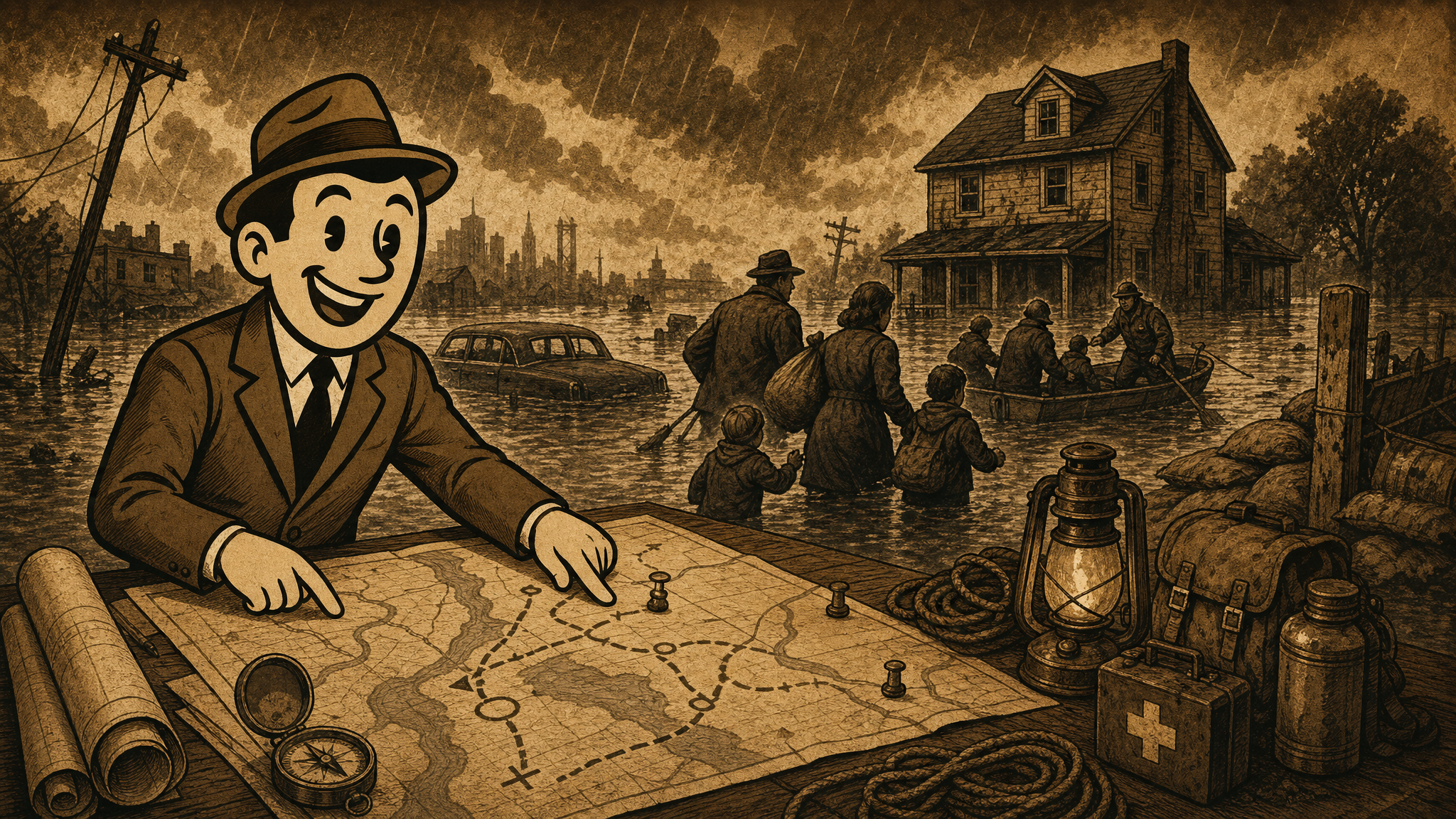
Families Trapped During Historic Flood Events
Flash floods do not just make things wet. They redraw the map while families are still trying to decide whether the road is “probably fine.” History is not subtle on this one: water wins arguments quickly.
Start inside the moment
Picture rain, wind, road updates, and neighbors making different choices at the same time. One family wants to wait. Another is already packing. Nobody wants to be the person who overreacts. That is the human reality behind this history: danger often arrives before certainty does.
That matters because families rarely make decisions with a clean timeline and perfect information. They make them while routines are still running, while other people are hesitating, and while the cost of acting early feels more real than the danger ahead.
Why “probably fine” is how floods catch families
The hardest choice in the moment was not between obvious safety and obvious danger. It was between normal life and an uncertain warning. Waiting often felt reasonable because other people were waiting too, officials or neighbors did not always agree, and the cost of acting early felt immediate.
This is why Defeat History focuses on patterns, not blame. The useful question is not whether people in the past should have known better. The useful question is what made the safer choice hard to see in time.
The historical pattern
During the historic July 2022 flooding in eastern Kentucky, the National Weather Service reported multiple rounds of training thunderstorms, deadly flash flooding, devastating river flooding, 24 Flash Flood Warnings, and several Flash Flood Emergencies. Much of the worst rain fell overnight into the morning, when families had less visibility and less time to react.
Why families get trapped
What history keeps repeating
| Historical signal | Family meaning | Modern preparation |
|---|---|---|
| Training thunderstorms repeatedly hit the same area. | Flash flooding can build faster than a household expects. | Take watches seriously; keep alerts active overnight. |
| Flood warnings escalated into emergencies. | The situation can change from inconvenient to life-threatening fast. | Know your higher-ground and stay-put options before the warning. |
| Roads and low-water crossings became dangerous. | The route you planned may not exist when you need it. | Map multiple routes and decide when you will stop driving. |
| Families can become isolated for days. | Food, water, medicine, light, sanitation, and phone power matter at home. | Build a several-day household function kit, not just an evacuation bag. |
The hard truth about flooded roads
NWS says more flood deaths occur each year than any other thunderstorm-related hazard, and over half of flood-related drownings occur when a vehicle is driven into hazardous flood water. NWS also warns that six inches of fast-moving water can knock over an adult, 12 inches can carry away most cars, and two feet can carry away SUVs and trucks.
Read the rest of this cluster
- How Roads Become Useless Faster Than People Expect
- How to Prepare if Flooding Suddenly Traps Your Family at Home
Sources
Next step: make the first 72 hours less chaotic.
The free First 72 Hours Field Guide helps families recognize disruption patterns early and act without panic. If household buy-in is the hard part, Bug In Without Freaking Out Your Spouse gives you a calmer way to build a plan together.
How this pattern can show up today
Today the pattern may show up through flash flooding, blocked roads, evacuation delays, bridge closures, power outages, and alerts that change faster than a family can comfortably react.
Imagine a road you use every day is now covered with water. A neighbor says they made it through. A warning says turn around. Your family has to decide whether one errand is worth the risk.
The preparedness lesson is not to live scared. It is to notice the moment when a familiar system starts behaving differently, then take one calm step before the easy options narrow.
What a normal family should take from this
- Do not drive through floodwater to preserve a normal errand.
- Move cars, documents, chargers, and key supplies before roads become the problem.
- Pick one early warning trigger your household will act on before everyone agrees it is serious.
- Choose one boring backup for the system discussed in this article.
- Talk through the decision calmly before the next alert, shortage, outage, or warning.
The goal is not to predict the future perfectly. The goal is to give your family a few prepared decisions before stress, noise, and social pressure make those decisions harder.
