
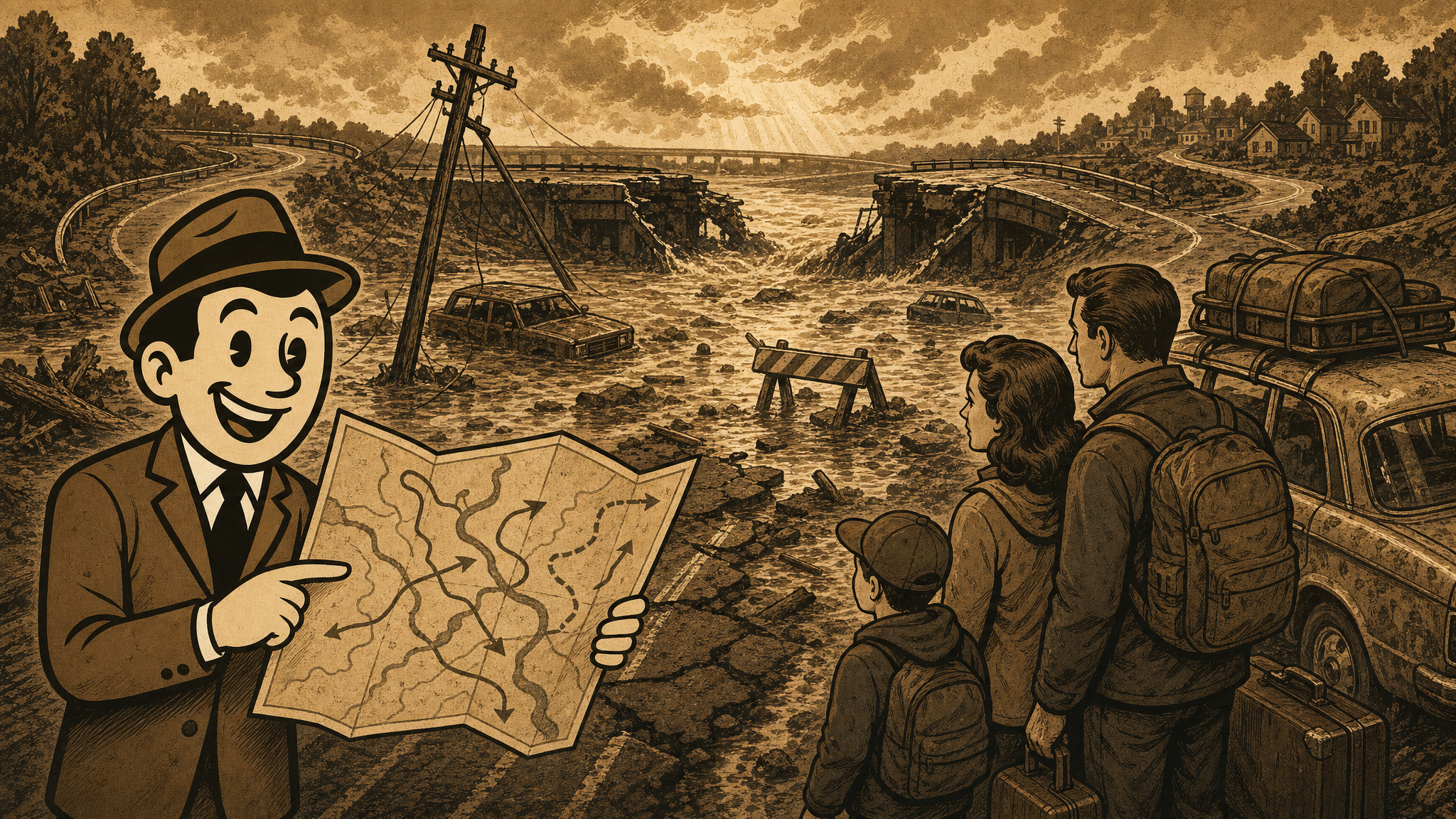
How Roads Become Useless Faster Than People Expect
Most families do not have a flood plan. They have a route they assume will work. Then one low spot fills, one bridge closes, one underpass floods, and suddenly the plan is a rumor.
How a normal route fails before the plan does
The question is not whether history repeats in the exact same costume. It usually does not. The useful question is whether the same pressure pattern can move through modern systems families depend on every day.
In a modern household, this pattern can move through roads, bridges, drainage, alerts, evacuation timing, utilities, schools, and emergency services. The first signal may not feel dramatic. It may look like a warning that seems local until travel options shrink, a confusing alert, a neighbor making a different choice, or a normal routine that suddenly takes more effort than it should.
Why the first decision feels unclear
Most families do not get a clean announcement that says, “This is the moment.” They get partial information. One update sounds serious. Another sounds routine. One spouse wants to act. Another wants to wait. Nobody wants to scare the kids or look foolish in front of neighbors.
That uncertainty is the real lesson. The danger pattern matters most before everyone agrees it is obvious.
What it can look like at home
Imagine the first sign shows up during an ordinary day. Work still expects you, school is still open, dinner still has to happen, and the family has not yet agreed whether this is “real.” The prepared move is not panic. It is a small early action: check the official source, confirm the family plan, protect the fragile system, and decide what trigger would change your next step.
The modern road-failure chain
Ready.gov says floods can develop slowly or quickly, and flash floods can come without warning. Flooding can cause outages, disrupt transportation, damage buildings, and create landslides. That means the family problem is not just whether your house floods. It is whether roads, bridges, stores, schools, jobs, and pharmacies remain reachable.
Why water fools drivers
- You cannot see the roadbed. The road may be washed out under the water.
- Depth is deceptive. NWS says a foot of rushing water can carry away most cars.
- Current beats confidence. A heavy vehicle still floats and loses traction when enough water pushes it.
- Everyone else is improvising too. Traffic, detours, stalled cars, and emergency closures can make the “backup route” disappear.
What a road-isolation day can look like
| Time window | What changes | Better family move |
|---|---|---|
| Before rain peaks | Alerts mention flood watch/warning; roads still look normal. | Charge phones, move cars from low areas, confirm who is home and who is not. |
| Water rises | Low crossings, underpasses, and creek roads become questionable. | Do not test flooded roads. Move to higher ground or higher floor if needed. |
| Routes close | School/work/pharmacy/grocery routes may be blocked. | Switch to the home-function plan: food, water, medicine, light, sanitation, updates. |
| After water drops | Roads may still be damaged, contaminated, or closed. | Wait for official clearance; avoid floodwater and damaged infrastructure. |
Three decisions to make before the storm
Read the rest of this cluster
- Families Trapped During Historic Flood Events
- How to Prepare if Flooding Suddenly Traps Your Family at Home
Sources
Next step: make the first 72 hours less chaotic.
The free First 72 Hours Field Guide helps families recognize disruption patterns early and act without panic. If household buy-in is the hard part, Bug In Without Freaking Out Your Spouse gives you a calmer way to build a plan together.
