
Build water resilience without pretending wood is magic.
Hugelkultur can add water resilience to a backup food garden, but only when the site, drainage, wood, nitrogen balance, and soil depth are handled honestly.
The Catch
Yesterday’s No-Dig lesson was about building soil upward without tearing the yard apart. That is a useful move for a normal family because it lowers the drama. One bed, clean materials, no fantasy farm, no spouse wondering why the backyard suddenly looks like a municipal trench project.
The Water Lesson
Hugelkultur takes that upward-building idea and adds a harder water lesson: a garden bed can be built to hold more moisture, but water is never free. It has to go somewhere, it has to drain somewhere, and if you put the wrong wood in the wrong place, the old trick turns into a damp little problem with vegetables on top.
That matters now because the pressure point is obvious. A beginner can usually find seeds, compost, a shovel, and advice. What they cannot always control is a dry week, a watering restriction, a vacation, a broken hose, or a July stretch where the plants look like they are negotiating surrender by noon. A backup food garden that needs perfect watering is not much of a backup. It is a pet with leaves.
The old lesson behind hugelkultur is not “bury logs and forget watering.” That is internet shorthand, and internet shorthand has a habit of walking families into trouble with a grin on its face. The better lesson is colder and more useful: design the bed for water before the dry spell arrives.
What Hugelkultur Can Actually Do
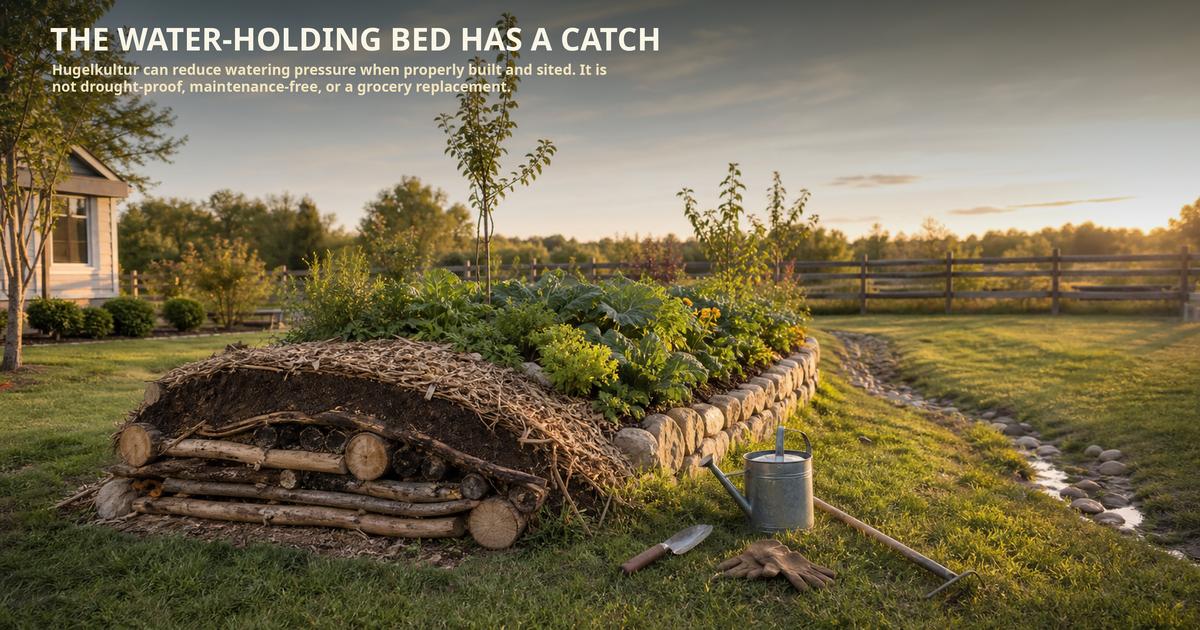
Hugelkultur is usually described as a raised or sloped bed built with wood and other organic matter under a soil layer. As that buried organic material breaks down, it can help hold moisture like a sponge. Oklahoma State Extension frames it as a water-conserving and stormwater-management technique when properly built and sited. That last phrase is where the hinge sits: properly built and sited.
A dry slope that sheds rain too fast is one kind of problem. A low corner of a wet yard with heavy clay is another. In the first place, buried wood and organic matter may help slow runoff and keep more moisture where roots can use it. In the second place, the same water-holding instinct can turn against you if the bed sits where water already pools. Roots need moisture. They also need air. A bed that stays soggy is not resilient; it is a slow argument with rot.
History is full of useful systems that got flattened into slogans after the people who understood the limits stopped standing nearby. Raised beds, terracing, mulch, composting, water harvesting, and old household garden practices were never magic tricks. They were site judgments. The family looked at slope, soil, sun, water, labor, and what they could afford, then built something that fit the pressure in front of them.
That is the part modern families need to recover. Not the romance. The judgment.
Where It Fits And Where It Fails
A hugelkultur bed can be a good fit when the family is fighting dry spells, runoff, weak soil structure, or the constant burden of dragging water to a bed that dries too quickly. It can be a bad fit when the yard already holds water, the soil is heavy clay, the wood is unsafe or unknown, or the family expects a mound of buried logs to do the work of gardening by itself.
The beginner mistakes are plain enough. Using fresh large wood without enough nitrogen-rich material can tie up the first season instead of feeding it. Planting into a mound with too little finished compost or topsoil can leave young roots stranded in a rough construction project. Using black walnut, contaminated scraps, painted lumber, old unknown treated lumber, railroad ties, creosote, or salvaged mystery wood around food is not thrift. It is gambling with the wrong stakes.
There is also the first-year disappointment. A new hugelkultur bed may still need watering during establishment. The buried organic matter has to settle, begin breaking down, and become part of the bed’s water rhythm. Anyone selling it as “self-watering forever” is either careless or trying to move you along before you ask better questions.
The Household Pressure Point
Here is what it would take for this old water lesson to matter today. A household starts a small food bed because grocery prices are tight, because storms have been knocking out routines, or because the family wants one more layer between dinner and a fragile supply chain. The first bed works in spring, then summer heat arrives, the school schedule changes, work gets ugly, the hose leaks, and watering becomes the task everyone meant to do yesterday. That is where gardens fail in normal homes: not because nobody cared, but because the system needed more daily attention than the family could keep giving.
Hugelkultur is one answer to that problem, if the site fits. It will not replace stored food. It will not feed a family by itself. It will not turn a bad plan into a good one. But as part of a starter garden system, it teaches the right lesson: water belongs in the design, not as an apology after the plants are already curled at the edges.
The Boring Checks That Matter
Before you build one, do the boring work. Boring is underrated. Boring keeps families from explaining later why the “simple garden project” became a muddy ridge full of questionable wood.
First, check drainage. After a hard rain, look at the yard before you touch a shovel. Where does water sit? Where does it run? Where does it vanish too quickly? A hugelkultur bed makes more sense where holding moisture helps, not where the yard already behaves like a shallow bowl.
Second, choose safe wood. Use clean, known materials, and avoid black walnut or allelopathic wood unless local guidance says otherwise. Do not use railroad ties, creosote, old CCA-treated lumber, Penta-treated lumber, painted scraps, stained mystery boards, or anything that came out of a pile you cannot identify. Extension guidance is more nuanced than “all treated wood is poison” or “all treated wood is fine,” but food beds are not the place to win an argument with salvage.
Third, balance the bed. Wood is carbon-heavy. A bed also needs nitrogen-rich organic matter and enough finished compost or topsoil on top for roots to live in now, not someday. If you only build for the future, the first plants pay the bill.
Fourth, start small. One test mound or raised bed is enough. The family does not need an earthwork monument. They need to learn whether this yard, this climate, this water pattern, and this maintenance schedule can handle the system.
This is where the First 72 Hours rule keeps everybody honest. A garden is future food. It is not what feeds your kids during the first three days after a storm, grid failure, boil-water notice, or local disruption. That first window still belongs to stored water, shelf-stable meals, a way to cook, a way to keep hands and dishes clean, and a plan the family can actually follow when routines are bent out of shape.
The garden comes after that. It is the next layer. It gives the household more options once the immediate disruption has passed and normal supply lines are still annoying, expensive, or unreliable. That is why the Emergency Food Garden Starter Kit frames this as a bed-and-water chooser, not a miracle seed promise. The first useful question is not “Which old system sounds impressive?” It is “Which system fits the yard we actually have?”
Do not worry. There is a plan here, and it does not require turning the family into a survival club. It is not guaranteed. Nothing with weather, soil, insects, and human schedules deserves that word. But it is better than standing in the yard with a wilted bed and a store receipt that makes you feel foolish.
If water is your weak point, build the plan cleanly:
Build The Plan Cleanly
- Walk the yard after rain and mark runoff, pooling, shade, and hose reach.
- Decide whether your problem is too little retained moisture or too much standing water.
- If the site fits, build one small hugelkultur-style test bed with clean wood, nitrogen-rich material, and a deep finished soil layer.
- Keep watering during establishment instead of believing the mound is already doing magic.
- Track what dries first, what stays wet, and what the family will actually maintain.
- Use the Starter Kit to compare hugelkultur against No-Dig, Keyhole, succession planting, and other systems before spending the whole budget on one idea.
The water-holding bed is not a shortcut around judgment. It is judgment made visible in the yard. Build it where it solves the right problem, and it can make a beginner garden less fragile. Build it because a stranger promised “self-watering,” and you are just burying hope under a pile of logs.
Hope is light. Wood is heavy. Choose accordingly.
Sources used for this lesson
Choose the bed before you buy supplies
Use the Emergency Food Garden Starter Kit to compare hugelkultur against no-dig, keyhole, succession planting, and other starter systems. If you still need the simplest first food-buffer path, start with the Backyard Backup Food Plan.
