
Food Forest for Beginners: Long-Term Food Resilience Without Fantasy Promises
Food forests play a longer game: layered perennials, careful site design, realistic expectations, and one modest move a normal family can maintain.
The Older Lesson: Perennial Food Was Never A Magic Trick
People like to talk about old food systems as if the ancestors were sitting on cheat codes. That is usually a sign the speaker has not spent enough time thinking about labor, weather, hunger, land access, and maintenance. Old systems survived because people knew their places, watched their seasons, and accepted work modern people like to rename as “low maintenance” so it sounds less expensive.
Perennial food has always had a different rhythm from annual crops. Annuals ask for planning, planting, fertility, water, pest watching, and harvest inside a tight season. Perennials ask for a longer kind of judgment. You choose a plant, place it where its mature size will not become a future problem, keep it alive through establishment, prune or manage it when needed, and wait for the payoff. The plant may outlast the person who first put it in the ground. That is the good news and the warning label.
The public memory of resilience likes the finished orchard, the berry hedge, the nut tree, the established vine. Household reality remembers the young plant that produced nothing useful the first year, the shrub that outgrew the walkway, the tree planted too close to a line, the “edible” fast-grower that turned invasive, and the family that bought ten things before learning where the wet corner of the yard actually stays wet.
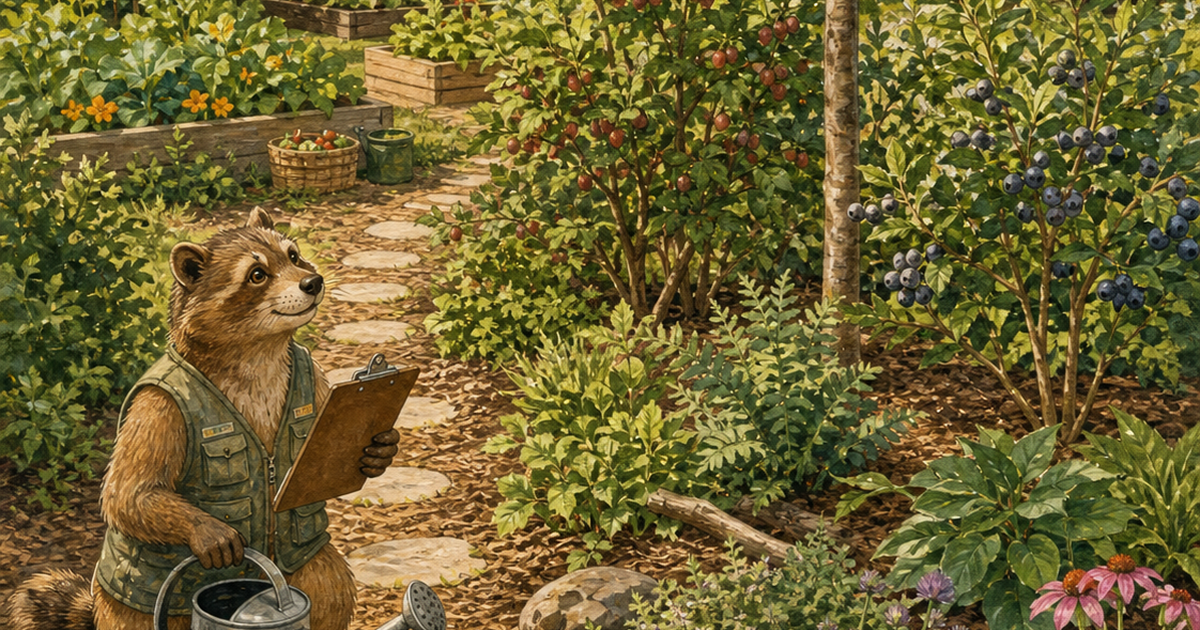
A real food forest uses layers. The cleared claim boundary supports the basic definition: overstory trees, understory trees and shrubs, herbaceous plants near the ground, roots, ground covers, and vines. That layered idea matters because it changes how a family sees the yard. Instead of treating every bed like a short-term crop slot, the food forest asks what the site can support over years.
That is useful. It is also unforgiving if you treat it like a shopping list.
The first mistake is planting too many perennials before mapping sun, water, mature size, roots, and access. A shrub that looks harmless in a pot can become a maintenance problem when it owns the path. A tree that seems noble on purchase day can shade the wrong bed later. A vine that promises abundance can become a wrestling match if it is wrong for the site. Some edible or fast-growing plants can also be invasive, and invasive plants are not a personality flaw. They are a land-management problem that can move beyond your fence.
That is why species-specific recommendations need local Extension, native plant, and invasive-species checks before anybody turns this into a public plant list. The broad lesson is ready. The regional shopping list is not.
What Food Forests Can Actually Do For A Household
A food forest gives a family a way to think beyond this year’s bed. That matters because annual-only thinking can trap beginners in the same loop: buy seeds, plant late, get overwhelmed, harvest a little, lose momentum, repeat next spring with slightly more guilt. Perennials can break part of that loop by putting some future food work into plants that return year after year when they are well chosen and managed.
The honest phrase is “can help.” Not “will feed your family.” Not “replaces groceries.” Not “plant once and do nothing.” I do not trust any garden promise that sounds like it was written by somebody who has never had weeds, drought, deer, clay soil, a sick kid, a full-time job, or a spouse looking at the yard like the project has crossed a line.
The normal-family version starts with one site-fit perennial layer. That might mean one edible shrub after local checks. It might mean a small berry edge where the sun and access make sense. It might mean a pollinator-supporting herb layer in a place the family already walks past, if the plants are suitable and noninvasive locally. It might mean doing nothing in the ground yet and spending a month mapping light and water because the yard has been lying to you all spring.
That last option annoys impatient people. Good. Impatience has killed plenty of gardens.
The first-year win is not a full basket. The first-year win is learning the site without turning the family against the project. You want to know where water pools, where summer heat hits hardest, what the household will actually maintain, which paths must stay clear, how much time watering really takes, and whether the family eats the food you are imagining. A plant that nobody wants to eat is not resilience. It is landscaping with a speech attached.
Food forests also force a useful budget discipline. Beginners can spend themselves into trouble by buying the dream all at once. The better move is colder: choose one layer, one location, one reason, and one maintenance plan. If the site proves itself, add another layer later. A household that can maintain one good perennial planting has learned more than a household that bought an edible jungle and then spent August pretending not to see it.
How This Pattern Could Matter Today
For a modern family, the food forest trigger path is not one dramatic collapse. It is more likely to be a stack: food prices grind higher, the family tries an annual garden, weather gets stranger at the edges, a few crops fail, grocery trips feel meaner, and the household realizes that every food decision is still short-term. That is usually how pressure works. It does not arrive wearing a sign. It shows up as another receipt, another late planting, another weekend lost, another bed that did not produce like the internet promised.
A food forest becomes relevant when the family wants long-term capacity without pretending one season will solve everything. If annual crops are the paycheck, perennials are closer to the slow account you build in the background. You still need the paycheck. You still need cash on hand. You still need the pantry. But a household with even a small, well-managed perennial layer has begun shifting some food potential into the future.
The scenario that makes this matter is not hard to imagine because it is ordinary. A family has a yard, but not much margin. They want to grow more food, but they do not want to become strange about it. They already learned that one spring project can become too much if it asks for every weekend. They need something that can grow with them over years, not another fragile burst of enthusiasm.
That is the food forest lane. Not instant security. Future harvest capacity.
The trigger path for failure is just as clear. A family skips the site map, buys plants from a pretty list, ignores mature size, chooses something invasive or unsuitable, plants too close to the house or access paths, forgets irrigation during establishment, and then gets disappointed when the system does not behave like the picture. The project becomes proof that preparedness is weird, expensive, and embarrassing.
That would be a shame, because the system did not fail first. The fantasy did.
First 72 Hours Comes Before The Orchard Dream
Before anybody starts talking like a berry hedge is an emergency plan, get the order straight.
The first 72 hours of a household disruption belong to water, food already in the house, a way to cook or eat without normal power, sanitation, medications, communication, documents, and a simple family plan. A young food forest will not help when the power is out tonight, the road is blocked tomorrow, or the store shelves are thin this weekend. A garden is a resilience layer. It is not a substitute for the first layer.
That is why the clean route for most families is the Backyard Backup Food Plan first. Use it to choose a realistic food-buffer path for the home you actually have. Map the site. Decide whether the first move should be a bed, containers, succession planting, a pest-pressure log, or one perennial layer. Keep the pantry and water plan ahead of the garden plan, because hunger does not care that your shrub is establishing.
If the family wants the deeper worksheets and system chooser, the Emergency Food Garden Starter Kit is the paid route. Use it as an organized shortcut, not as a fear purchase. The value is in avoiding beginner mistakes, keeping the project normal, and choosing the right system for the site instead of buying your way into a mess.
The Clean Family Plan After Trouble Has Already Started
Do not worry. There is a plan here. It is not guaranteed, and I would not trust anybody who promises one. But it is better than standing in the yard with a receipt, a shovel, and a fantasy.
First, separate immediate food from future food. If a disruption is already underway, do not expect the garden to rescue dinner. Use stored meals, water, and existing household supplies. If you do not have those, make that the first correction after the situation settles. The food forest belongs to the next layer, after the family is stable enough to think past the week.
Second, walk the site before you buy anything. Mark sun, shade, water access, wet spots, dry spots, utility areas, paths, kid traffic, pet traffic, and places a mature plant would become a problem. Do this more than once if you can. A yard at 9 a.m. and a yard at 4 p.m. are not the same witness.
Third, choose one perennial layer. One. If the site supports an edible shrub, research one that fits the region and check local Extension/native/invasive guidance. If a shrub is wrong, choose a smaller herbaceous layer or delay planting. Delay is not failure when the alternative is installing a future headache.
Fourth, write down the maintenance debt before planting. Establishment watering, mulch, pruning, pest monitoring, thinning, harvest handling, and access all count. If the household cannot support the maintenance, shrink the plan until it can. A modest system that survives beats a heroic plan that becomes yard guilt.
Fifth, keep annual food in the mix. Food forests are long game. Annual beds, containers, and succession planting are how a family learns faster and gets near-term harvest practice. The smart household uses both rhythms: annuals for this season, perennials for the years ahead.
Sixth, make the project normal enough that the family does not reject it. Say it plainly: “We are testing one long-term food plant that fits the yard.” That lands better than announcing a survival orchard like you are about to rename the property. Normal language keeps the house on your side.
Seventh, do not follow a region-specific plant list without fresh local checking. The broad system lesson is useful now. The exact plant choices need local authority because the wrong "helpful" species can become somebody else's problem.
The food forest lesson is simple enough, once the romance is scraped off: plant for the future, but do not lie about the present. A family still needs pantry food, water, and the first 72 hours handled. After that, one well-chosen perennial layer can become a quiet piece of household resilience.
That is not glamorous. Good. Glamour is expensive and usually late.
Sources used for this lesson
Choose the food layer honestly
Start with the Backyard Backup Food Plan if you need a clean first step for your household. Use the Emergency Food Garden Starter Kit when you want the deeper system chooser and worksheets without buying the fantasy version of a garden.
