
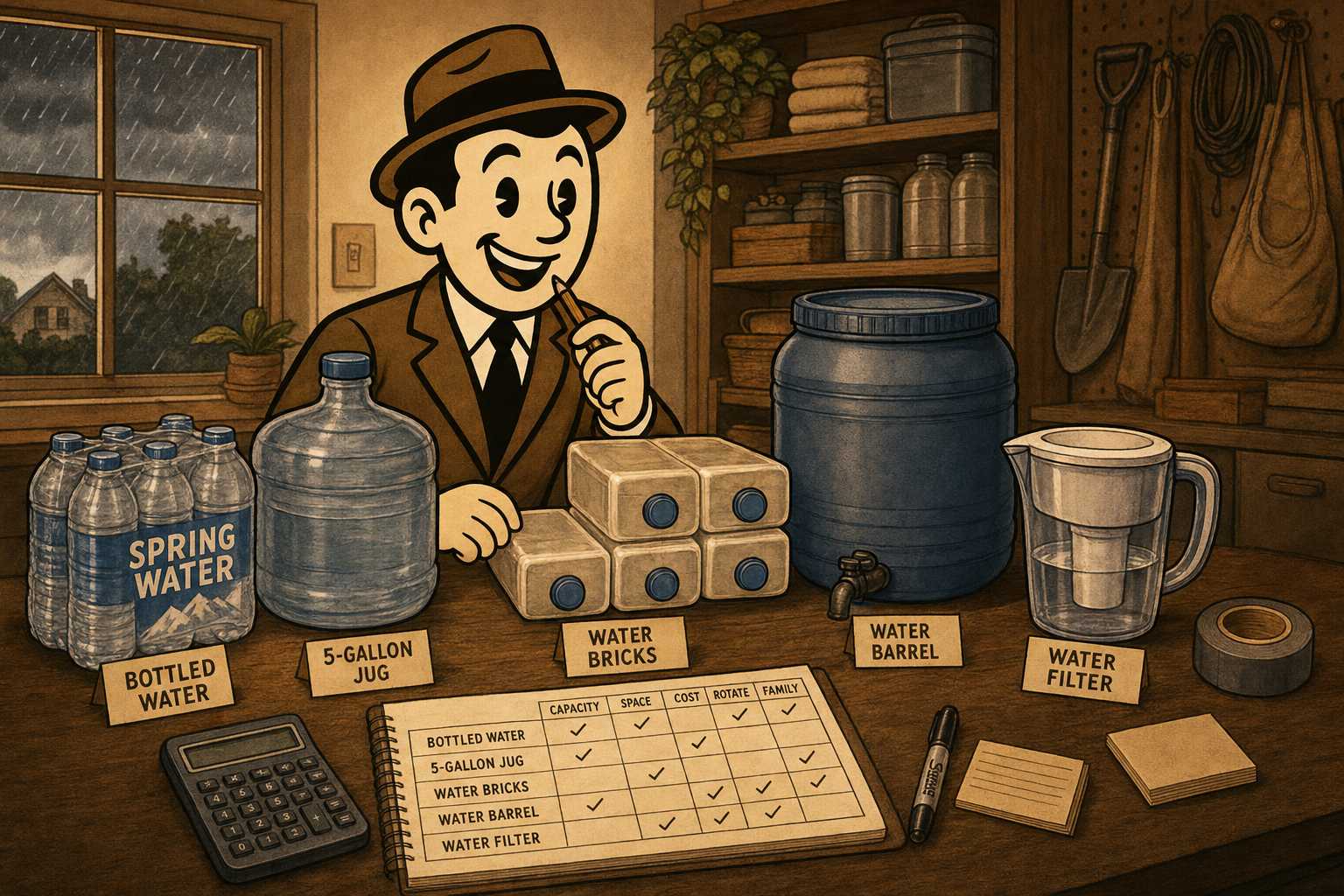
Best Water Storage Options for Normal Families
Most families do not need a dramatic water setup. They need enough clean water, stored where it will actually fit, labeled so everyone understands it, and rotated before it becomes another forgotten project in the garage.
This guide helps you choose water storage without panic buying, wasting money, or turning your home into Fort Weird.
Quick recommendation: start with your household number, then build a boring first layer before buying bigger containers. Use the Family Water Security Calculator first if you do not know your number yet.
The baseline: how much water should a family store?
Ready.gov and CDC both use the same practical planning baseline: at least 1 gallon per person per day, with a 3-day minimum and a 2-week supply if possible. Children, pregnant women, sick people, pets, hot climates, medical needs, and sanitation needs can push that number higher.
That means a family of four should think in layers:
| Goal | Household target |
|---|---|
| 3 days | 12 gallons minimum |
| 7 days | 28 gallons minimum |
| 14 days | 56 gallons if possible |
That number matters because buying containers before doing the math is how families end up with either too little water or a giant barrel nobody knows how to use.
Best first option: commercially bottled water
Best for: beginners, renters, small apartments, quick setup, skeptical spouses, and households that need a visible win this week.
Commercially bottled water is the easiest first layer because it arrives sealed, familiar, portable, and simple to explain. It is not fancy. That is exactly why it works.
Pros
- Fastest way to get a real 3-day baseline.
- Easy to split across closets, pantries, cars, or bedrooms.
- No cleaning or filling containers up front.
- Familiar enough that family members do not treat it like strange prepper gear.
Watch-outs
- Cases can be awkward, messy, and weak over time.
- Individual bottles create more plastic waste.
- It can be more expensive per gallon than larger containers.
- Check dates and store in a cool, dark place.
Defeat History take: if your family currently has almost no stored water, buy the boring case first. Action beats research paralysis.
Best small-space option: 1-gallon jugs
Best for: apartments, renters, closets, under-sink areas, small pantries, and families who need water that is easy to carry.
One-gallon jugs are underrated because nearly everyone can move them. A giant container is useless if only one adult can lift it.
Pros
- Easy to count: one jug equals one person-day baseline.
- Easy for teens, grandparents, and many spouses to carry.
- Fits in odd corners better than a barrel.
- Good for splitting water across the home.
Watch-outs
- Store-bought disposable jugs can leak over time.
- Not ideal for long-term stacking.
- Rotate and inspect regularly.
Defeat History take: for normal families, 1-gallon jugs are often the best bridge between “we should do something” and “we actually did something.”
Best normal-family upgrade: 5–7 gallon water containers
Best for: households with a closet, garage shelf, laundry room, basement, or pantry floor space.
A 5–7 gallon container gives you useful volume without jumping straight to barrel territory. It is the sweet spot for many families.
Pros
- Much stronger storage layer than loose bottles.
- Still movable by many adults when full, though heavy.
- Often designed for camping/emergency use.
- Easier to label and rotate than scattered bottles.
Watch-outs
- Full containers are heavy: water weighs about 8.3 pounds per gallon.
- Needs cleaning/sanitizing if you fill it yourself.
- Must be food-grade and tightly closable.
- Needs a pour plan: spigot, pump, or small transfer pitcher.
Defeat History take: after the basic case or jugs, this is the first serious upgrade I like for normal families. It is useful without being theatrical.
Best modular option: stackable water bricks
Best for: closets, apartments, renters, organized garages, and people who want neat modular storage.
Stackable water bricks cost more, but they solve a real household friction problem: shape. They are easier to distribute around the home and easier to scale gradually.
Pros
- Clean, modular, and less visually chaotic.
- Easier to add over time.
- Often easier to hide in normal storage areas.
- Good for spouse-safe organization.
Watch-outs
- Higher cost per gallon.
- Still heavy when full.
- Some designs require separate spigots or caps.
- Not necessary before you have your basic household number.
Defeat History take: good if space and appearance are the reasons your family keeps delaying water storage. Not required for everyone.
Best high-volume option: 30–55 gallon barrels
Best for: homeowners with garage/basement space, larger families, rural households, and people building beyond the first 72 hours.
Barrels hold serious volume. They also bring serious friction. You need location, filling, treatment, rotation, and access plans before buying one.
Pros
- Strong gallon-per-dollar value.
- Good for building a 1–2 week reserve.
- Helpful for larger households.
Watch-outs
- Not portable once full.
- Needs a pump or siphon plan.
- Needs food-grade storage and safe cleaning.
- Can look extreme to a skeptical spouse if introduced badly.
- Bad first purchase if you have not calculated needs or storage location.
Defeat History take: barrels are not bad. They are just usually not the first move. Earn the barrel by finishing your basic layer first.
Where filters fit — and where they do not
Filters are useful, but a filter is not the same thing as stored water. If the tap is unavailable, frozen, shut off, or unsafe in a way your filter does not handle, you still need water on hand.
Good role for filters
- Backup layer after stored water.
- Camping/travel/emergency use when a questionable source must be treated.
- Reducing dependence once the first stored layer exists.
Bad role for filters
- Excuse for storing no water.
- Treating every contamination type without checking what the filter is rated for.
- Replacing official boil-water or do-not-drink instructions.
Defeat History take: store water first, then add treatment options. Do not let gear theater replace gallons.
What not to buy first
Do not start with the most dramatic option. Avoid:
- Giant barrels before you know your household number.
- Containers that are not food-grade.
- Used containers that held chemicals, cleaners, pesticides, fuel, or unknown liquids.
- Glass containers for emergency storage.
- Fancy systems that only one adult understands.
- Filters that you have not matched to the actual threat.
- Anything your family cannot lift, find, label, or use.
CDC recommends food-grade containers when filling your own water and warns against containers previously used for toxic chemicals. Ready.gov also recommends replacing non-commercially bottled stored water every six months.
The normal-family buying sequence
1. Calculate the household target. People, pets, heat, medical needs, babies, and sanitation.
2. Buy or gather the first 3-day layer. Bottled water or 1-gallon jugs are fine.
3. Choose the storage location. Closet, pantry, laundry room, under-bed bin, garage shelf, basement shelf.
4. Upgrade only the weak part. Too scattered? Use stackables. Need more volume? Use 5–7 gallon containers. Need 2 weeks? Consider barrels.
5. Label and rotate. Date filled or purchased, intended use, and review date.
6. Teach the household. Where it is, what it is for, when not to use the tap, and who decides.
Recommended setups by household type
| Household | Best starting setup |
|---|---|
| Apartment/renter | Bottled water + 1-gallon jugs split across closets |
| Family of 3–5 | 3-day bottled baseline + two 5–7 gallon containers |
| Spouse skeptical | Start with normal bottled water and label it “storm/water notice backup” |
| Small budget | Add one case or 2–4 gallons per grocery trip until baseline is done |
| Larger home | 5–7 gallon containers first, then barrel only after location is chosen |
| Pets/babies/medical needs | Store beyond the minimum and keep use instructions obvious |
Bottom line
The best water storage option is the one your family will actually maintain. For most normal families, the winning path is boring:
Calculate your number → buy the first 3-day layer → choose containers that fit your home → label everything → review twice a year.
That is not panic. That is margin.
Sources
- Ready.gov: Water guidance recommends at least one gallon per person per day for several days and notes higher needs for children, nursing mothers, illness, medical emergencies, and hot climates.
- CDC: Emergency water supply guidance recommends at least one gallon per person per day for three days, trying for two weeks if possible, using food-grade containers, and replacing self-filled stored water every six months.
Want the printable version?
The Water Readiness Mini-Bundle turns this buyer guide into worksheets, labels, a rotation checklist, a water-notice action card, and a spouse-safe planning script.
