
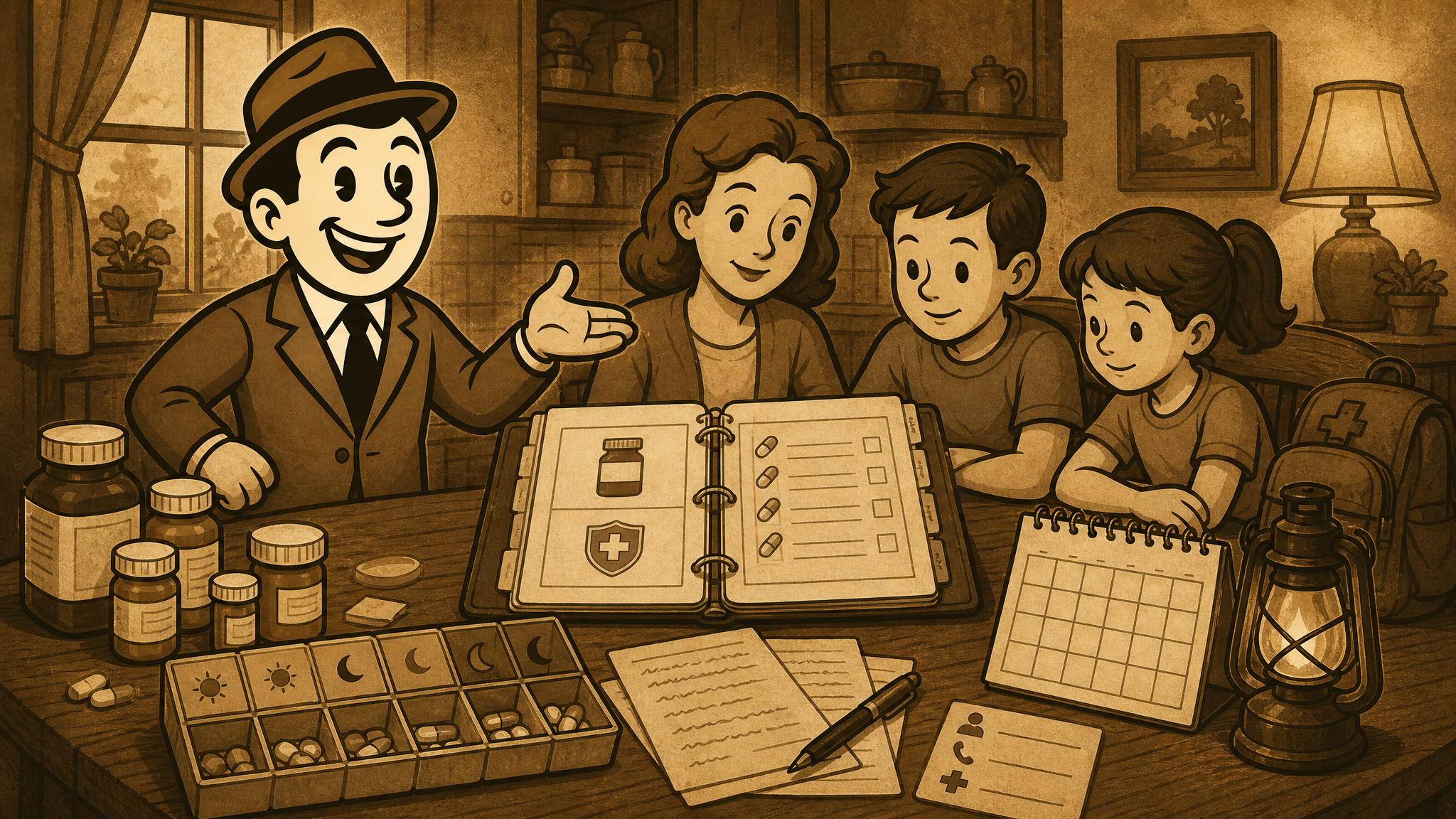
How Families Can Prepare for Medication Interruptions
The goal is not to become your own pharmacist. The goal is to make sure your family is not trying to remember names, dosages, allergies, refill rules, and phone numbers while everyone is tired and the pharmacy line is wrapped around the building.
Set the refill trigger before the pharmacy gets hard
The practical lesson is not “be afraid sooner.” It is to decide what your family will do when the first useful signal appears. A trigger turns vague concern into a calm household action.
A good trigger is specific enough to use, ordinary enough to explain, and early enough that the easy options are still available.
The calm first moves
- Know refill windows: Ask how early refills can happen and what the safe, legal buffer options are.
- Write the medication plan down: Keep medication names, doses, pharmacy contacts, doctor contacts, and insurance details accessible.
- Plan for closures: Storms, outages, road closures, and supply issues can all make normal refill timing fragile.
Keep it normal enough to use
The goal is not to win an argument about worst-case scenarios. The goal is to make the next step feel reasonable inside a normal home. Use language like, “This is for the next power outage,” “This keeps the kids comfortable,” or “This saves us a stressful store run.”
Preparedness works best when it lowers household stress instead of adding to it.
The family-safe principle
CDC’s prescription preparedness guidance starts with simple, practical steps: talk to your doctor or pharmacist about creating an emergency supply of medicines; keep a prescription list with diagnosis, dosage, frequency, medical supply needs, and allergies; store common nonprescription medicines; and plan for refrigerated medicines with a cooler and chemical ice packs.
The 30-minute medication access plan
- Make the list. Medication name, dose, frequency, reason/diagnosis, prescribing doctor, pharmacy, allergies, insurance/prescription card details, and medical supplies.
- Print it. Keep one copy in your emergency folder and one with the responsible adult who manages care.
- Ask early. Talk to your doctor or pharmacist about whether an emergency supply, early refill, 60/90-day fill, or other lawful option makes sense for your situation.
- Know alternate pharmacies. Save at least two nearby pharmacy options and one farther outside your immediate area.
- Plan for cooling. If any medicine requires refrigeration, ask your pharmacist about safe temperature ranges and have a cooler/chemical ice packs plan.
- Learn your state’s emergency refill rules. CDC notes emergency prescription refill laws vary by state and can matter during declarations.
- Do not wait for empty. Refill timing is part of preparedness. Empty bottles are terrible emergency managers.
What to ask your pharmacist
| Question | Why it matters |
|---|---|
| “How early can this usually be refilled?” | Prevents accidental last-minute dependence. |
| “What should we do if this is unavailable?” | Creates a clinician-approved path instead of panic improvisation. |
| “Does this need refrigeration or special storage?” | Power outages can turn storage into the real problem. |
| “Can this prescription transfer if our usual pharmacy is closed?” | Disaster access often depends on transfer rules and records. |
| “What emergency refill rules apply in our state?” | CDC specifically recommends learning how state emergency refill laws can help. |
Spouse-safe framing
If this feels too medical or too serious to bring up at home, keep it plain:
That is not fear. That is household competence with receipts.
This article is general preparedness education. Always follow your doctor, pharmacist, medication label, and official emergency guidance.
Read the rest of this cluster
- How Medicine Shortages Hit Families During Major Disasters
- What Happens If Prescriptions Become Hard to Fill
Sources
Next step: make the first 72 hours less chaotic.
The free First 72 Hours Field Guide helps families recognize disruption patterns early and act without panic. If getting the household on board is the hard part, Bug In Without Freaking Out Your Spouse gives you a calmer way to build a plan together.
