
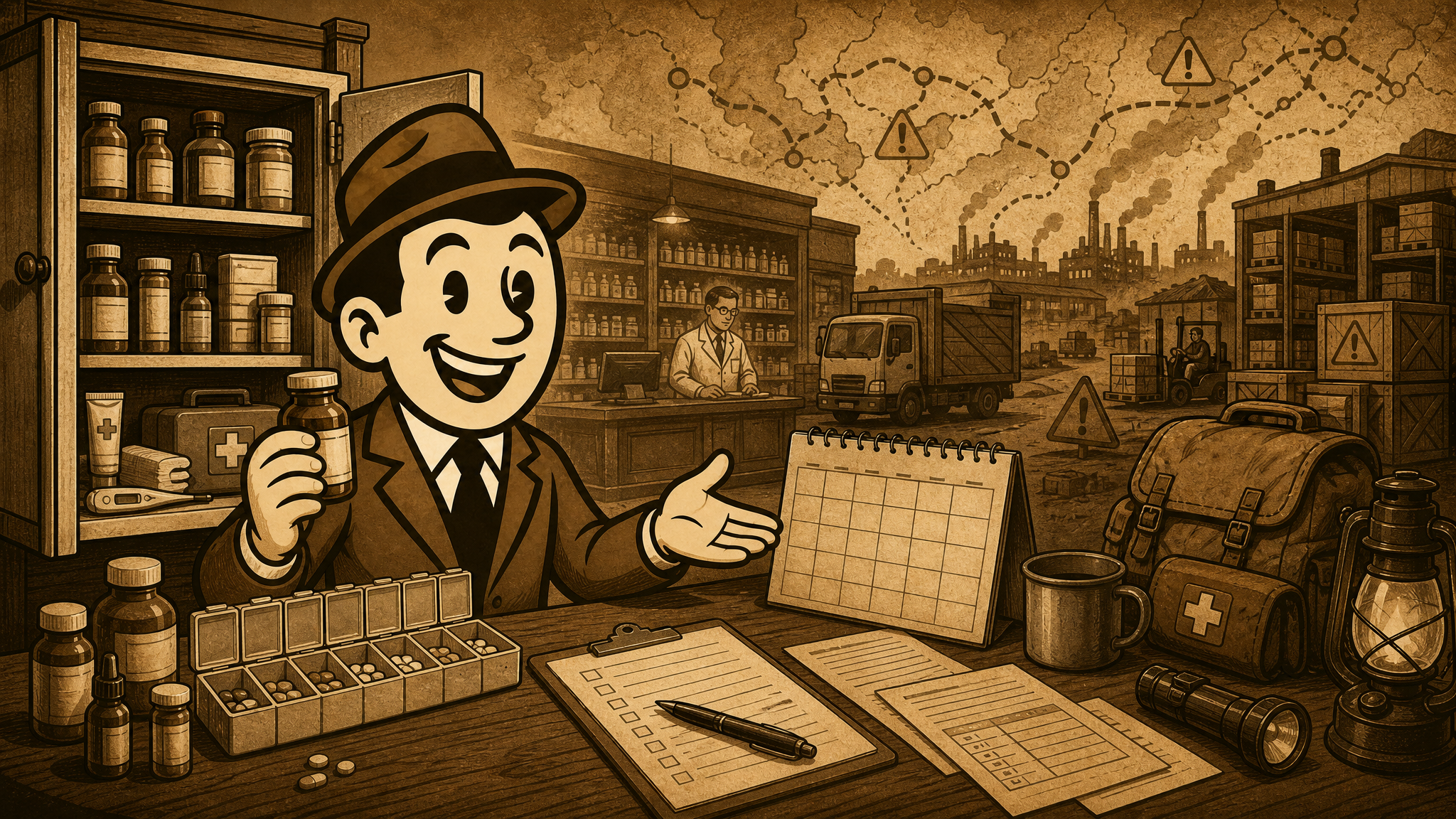
What Happens If Prescriptions Become Hard to Fill
A prescription disruption rarely announces itself like a movie alarm. More often it shows up as a phone call, a closed pharmacy gate, a refill delay, or the sentence no parent wants to hear: “We do not have that in stock.”
The pattern behind this modern scenario
The question is not whether history repeats in the exact same costume. It usually does not. The useful question is whether the same pressure pattern can move through modern systems families depend on every day.
In a modern household, this pattern can move through pharmacies, wholesalers, insurance systems, road access, clinic hours, and prescription timing. The first signal may not feel dramatic. It may look like a refill delay that collides with a storm, closure, or supply shortage, a confusing alert, a neighbor making a different choice, or a normal routine that suddenly takes more effort than it should.
Why the first decision feels unclear
Most families do not get a clean announcement that says, “This is the moment.” They get partial information. One update sounds serious. Another sounds routine. One spouse wants to act. Another wants to wait. Nobody wants to scare the kids or look foolish in front of neighbors.
That uncertainty is the real lesson. The danger pattern matters most before everyone agrees it is obvious.
What it can look like at home
Imagine the first sign shows up during an ordinary day. Work still expects you, school is still open, dinner still has to happen, and the family has not yet agreed whether this is “real.” The prepared move is not panic. It is a small early action: check the official source, confirm the family plan, protect the fragile system, and decide what trigger would change your next step.
The modern failure chain
CDC warns that an emergency can make it difficult to refill prescriptions or find an open pharmacy. Ready.gov adds that after a disaster, families may not have access to a medical facility or even a drugstore, so they need to plan for daily needs before those needs become limited or unavailable.
What families may notice first
How it can escalate
| Stage | What changes | Family move |
|---|---|---|
| First signal | Refill is delayed, pharmacy hours change, or stock is uncertain. | Call early; ask the pharmacist what safe next steps exist. Do not improvise dosing. |
| Same day | Multiple pharmacies may be busy or difficult to reach. | Use your printed medication list and prescriber contacts to reduce confusion. |
| Disaster conditions | Power, roads, payment systems, or refrigeration may be part of the problem. | Check official emergency updates and open-pharmacy resources when available. |
| Extended disruption | Alternatives, emergency refill rules, or transfer options may matter. | Work through your doctor, pharmacist, insurer, and state emergency-refill rules. |
Important safe-not-weird rules
- Do not change medicine on your own. The safe move is to talk with a doctor or pharmacist, especially for critical medications.
- Keep names exact. Know the medication name, dose, frequency, prescribing doctor, pharmacy, allergies, and medical supply needs.
- Know what needs cooling. CDC and Ready.gov both point to planning for medicines that need refrigeration, including a cooler and chemical ice packs.
- Use official shortage information carefully. FDA’s Drug Shortages Database can show current shortages, but your clinician/pharmacist is still the household decision point.
Read the rest of this cluster
- How Medicine Shortages Hit Families During Major Disasters
- How Families Can Prepare for Medication Interruptions
Sources
Next step: make the first 72 hours less chaotic.
The free First 72 Hours Field Guide helps families recognize disruption patterns early and act without panic. If getting the household on board is the hard part, Bug In Without Freaking Out Your Spouse gives you a calmer way to build a plan together.
